
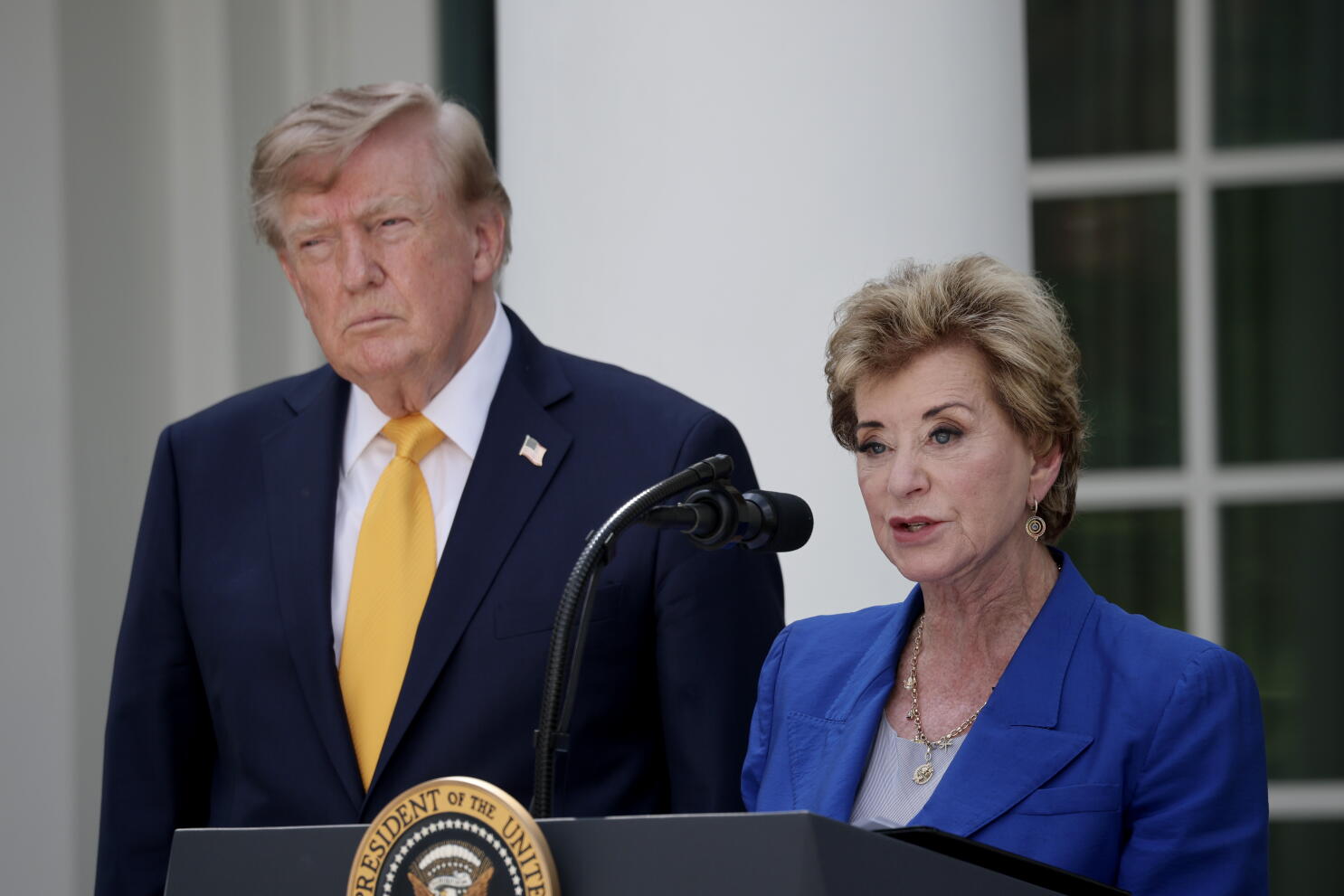
Education was not a driving force in the November midterm elections, but the blue wave that swept Democratic majorities into the House and Senate will affect education policies and priorities — even as President Trump shows no sign of retreating from his own agenda. The Trump agenda includes: Going after states and school systems that allow transgender students to participate in girls’ and women’s sports.
Enacting a nationwide taxpayer-funded plan to pay tuition at private grade schools. Shifting student loans to the private sector.Reducing federal oversight attached to federal money. Dismantling the U.S. Department of Education.The administration also has targeted diversity, equity and inclusion efforts, treating them as a form of discrimination, and has tried to exert direct control over the flow of research grants — with critics alleging that such actions are tainted by ideology and strong-arm pressure tactics.
The administration’s quick and dramatic moves have led to lawsuits alleging substantive and due process violations. Last week, the Trump administration made clear that observers should expect more of the same, with a press release asserting that the Education Department “is continuing its historic fight to restore parental rights protections by opening several investigations and moving forward with enforcement actions” related to “alleged incidents that involve hiding students’ ‘gender transitions’ from their parents.” The latest targets are the public school systems in Albuquerque and Santa Fe, N.M.
The path ahead for congressional Democrats, analysts say,
The path ahead for congressional Democrats, analysts say, would be to use the power of the purse first to slow Trump down, then to achieve a stalemate and finally to push in another direction on issue after issue, with hopes of making gradual headway. Analysts from around the country and from different political perspectives are gauging what they think will happen, and what Democrats could and should do: “Whatever power Democrats will hold in the next two years will derive from their control of the budget.
They can’t reverse Trump’s downsizing of the Department of Education. They can’t force the Civil Rights Division of the Justice Department to uphold civil rights laws. They can’t write and pass laws, because Trump will veto whatever they pass. But they can block Trump’s agenda using the powers they have.” — Diane Ravitch, education historian _______________ “They should prioritize restoring the $1.9 trillion — by our count, over 10 years — that Trump and his congressional allies robbed from students and their families to fund tax breaks for billionaires …
Democratic governors now have a clear mandate from voters to reject the administration’s private school voucher program, which is a grave and urgent threat to the public schools that serve nearly 90% of the nation’s K-12 students.” — Randi Weingarten, president, American Federation of Teachers _______________ “A Democratic Congress will certainly try to put Humpty Dumpty together again, requiring most policies and programs to return to the U.S.
Department of Education properistration to slow-walk the implementation,
Department of Education properistration to slow-walk the implementation, and possibly fight it out in court. This will take time and probably won’t happen before — and unless — a Democrat wins the White House in 2028.” — Mike Petrilli, president, Thomas B. Fordham Institute _______________ “For the next two years, the Trump administration will be stuck on the defensive instead of further advancing
reforms [facing] a hostile legislature that will block further initiatives, threaten existing ones, and impose potentially crippling oversight.” — Daniel Buck, director of Conservative Education Reform Network at the American Enterprise Institute, writing in the National Review. _______________ “I’d expect oversight, with a vengeance. There are a lot of potential targets, so the ones that might make the cut will be those that advance a larger Democratic narrative about corruption, malign influence and affordability.” Expected targets would include the federal student loan program, the actions of Elon Musk’s team at the Department of Government Efficiency, or DOGE, education research decisions and the transfer of programs out of the Education Department.
— Frederick Hess, director of education policy studies at the American Enterprise Institute
