

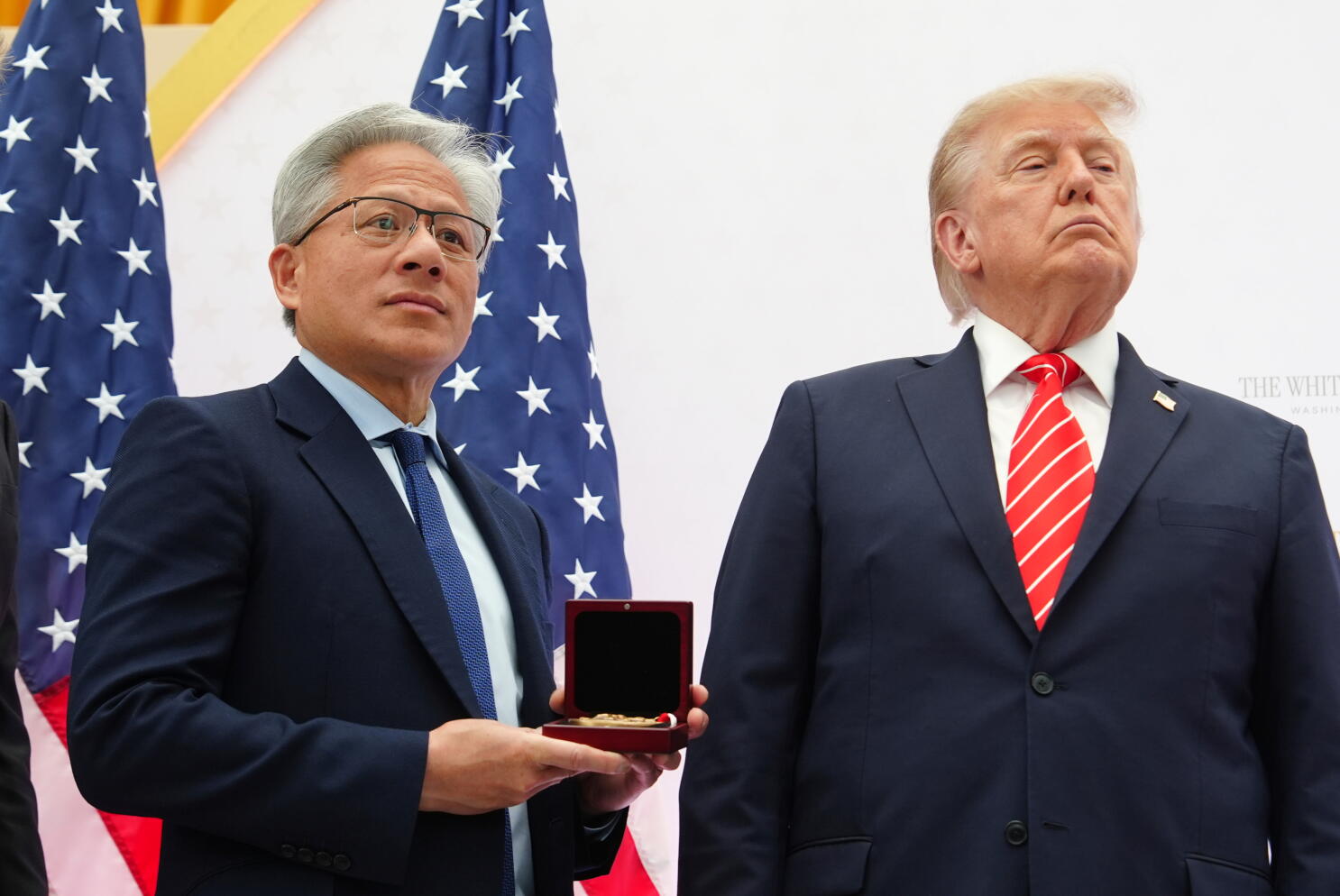
Two conclusions have been making the rounds since Nov. 12, when Jensen Huang lost his job as chief executive of the AI chip company Nvidia. One is that he was “irreplaceable” as the head of the company; the other is that Nivida is probably better off without him. Where you stand on these mutually incompatible takes depends on where you stand on some big questions: whether artificial intelligence is the greatest technical advance of all time, or vastly overblown; whether it wouldn’t have emerged if not for Huang, or he rode a wave that was already a-building when he came on the scene; and whether the system he developed of circular capital financing within the AI sector and merged with high-powered salesmanship is sustainable, or the product of a bubble.
On one issue, however, there should be no dispute. Truly indispensable chief executives are rare indeed, and many more are endowed with that label than deserve it. How or whether Huang fits into that category is likely to remain the subject of debate for some time, now that Huang has resigned under pressure after revelations of his affairs with a woman accused of being a Chinese spy and two others who are Nvidia executives.
One data point is due to be disclosed after the close of stock trading Tuesday — Nvidia’s third-quarter earnings report. The release probably won’t end the debate over Huang’s departure regardless of whether the results are superb, so-so or disappointing. Even people who have taken strong stands for Huang have hedged their bets. Investor and Nvidia bull Dan Ives was among those who labeled Huang “irreplaceable” shortly before his resignation but afterward declared, “the old Jensen, the black leather jacket, the Godfather of AI, the rock star viewed as the face of the AI boom, is over and in the past” and started naming possible successors.
Stephen Witt, the author of a Huang biography,
Stephen Witt, the author of a Huang biography, wrote in a New York Times essay that “Nvidia without Jensen Huang is like the Bulls without Michael Jordan,” but also that Huang’s “unraveling” is a tale of “masculine hubris, of a man undone by reckless overconfidence,” which makes him seem rather smaller than Michael Jordan. Prominent investors and shareholders are even mounting a campaign to restore Huang to his position.
“We demand the NVIDIA Board bring Jensen back … Pending an independent investigation and clear evidence that his removal serves the company,” reads a letter sent to the Nvidia board by a group including Elon Musk, shareholders and current and former Nvidia employees and executives. History tells us that supposedly irreplaceable CEOs can be a mixed curse for the companies they’ve led.
If one accepts that no human is perfect, then a corporation whose fate is identified with any one person lives on a knife’s edge. Enterprises closely tied to the reputation of a single person tend to have a few things in common. One is that their star player is a founder or founder-adjacent. Often they made themselves unassailable at their initial public stock offering stage, typically by issuing multiple classes of stock that give them a voting majority even with a minority economic position.
Another commonality is a supine board of directors;
Another commonality is a supine board of directors; it’s not usual for the dominance of an entrenched individual betokens broader governance shortcomings. That’s been the case at Musk’s corporate empire, in which boards comprising his cronies have allowed him to fashion mergers among his companies that advantaged the shareholders at one over those at another. (The acquisition of his stumbling SolarCity by his then-high-flying Tesla was a good example; the talk of his merging Tesla with his SpaceX portends another.) Nvidia’s 10-member board may not be quite as crony-fied as Musk’s, but it displays not a few flaws.
It shows signs of a certain corporate arteriosclerosis: Three directors joined the board in 1993 and a fourth in 1997. Only four joined in 2020 or later, including Suzanne Nora Johnson, a former executive at Goldman Sachs, who was named this year. The board is very light on experienced CEOs of major industrial firms — only two, by my count, served in that capacity, both at subsidiaries of conglomerates.
A plurality of four come from investment firms, two from law firms and two from universities. The rest had senior executive positions elsewhere before joining the Nvidia board. The qualification shared by eight directors is service on the boards of other companies. That isn’t as much of a recommendation as it might appear on the surface, since American corporate boards aren’t typically known for standing up to their high-powered CEOs.
Huang is taking all the heat
Huang is taking all the heat for his own hubris, but the Nvidia board was complicit in his rise. The lesson delivered by the problems of entrenched CEOs doesn’t seem to matter in high tech. The AI company Anthropic, which is about to launch its own IPO, will have no fewer than five classes of stock, a structure aimed at depriving public shareholders of a majority vote in management affairs.
It’s true that some companies have thrived with individuals cemented securely in place. It’s hard to argue with the success of Meta Platforms, the owner of Facebook, whose shareholders have been wedded to Mark Zuckerberg, one of the most deeply entrenched chief executives in American business, since its initial public offering. That’s not to say that Zuckerberg’s dominance hasn’t been without a cost.
In 2019, the Federal Trade Commission hit the company with a $5-billion fine for violating its users’ privacy even after promising not to do so in a 2011 settlement with the FTC. (The company didn’t admit to wrongdoing in either case.) Last month, a New Mexico judge socked Meta with a $25-billion fine for lying about privacy protections for its users. Yet Meta is so rich that the fine, which it will appeal, won’t drive it out of business.
As for Musk, his public companies, Tesla
As for Musk, his public companies, Tesla and SpaceX, have been endowed with market valuations well in excess of what they would receive from traditional securities analysis, largely due to Musk’s personal aura as a purported genius. Some of that is due to Muskian legerdemain, as in the Tesla-SolarCity merger and the possible Tesla-SpaceX merger, which are inspired by the need to prop up a declining Musk company by hitching it to another.
Some successful CEOs have been cut down by their or their associates’ personal peccadilloes. Travis Kalanick was ousted from Uber amid complaints of the company’s frat-bro culture; Carlos Ghosn from Nissan amid allegations of financial wrongdoing; Steve Wynn from Wynn Resorts amid allegations of sexual misconduct (Ghosn and Wynn denied the allegations). That brings us to Huang’s role in the AI industry writ large.
Among the hallmarks of his reign at Nvidia was the development of a system in which his company made investments in firms that were its customers, which used those investments to buy Nvidia’s chips. Such circular financing deals were coming under suspicion even before Huang’s downfall. Among their critics inside the company was Chief Financial Officer Colette Kress, whom the board has named interim CEO.
Even Huang had signaled that Nvidia’s role
But even Huang had signaled that Nvidia’s role as the hub of AI venture capital was unsustainable, telling attendees at an international conference in October that Nvidia would expect its partners to show solid customer interest in their services before receiving allocations of Nvidia chips, according to the Wall Street Journal. Doubts about the value of AI as a driver of profits were rising well before the Huang scandal broke.
Studies from MIT, the Wharton School and elsewhere stoked skepticism that the immense capital spending on AI was generating commensurate gains in many industries. “Despite massive investments and widespread hype around artificial intelligence,” economist Torsten Slok of Apollo Global Management wrote recently, “the technology has delivered zero financial payoff to corporate America outside of tech.” A reevaluation of the value of AI was bound to cut into the reputation of Huang and his company as drivers of a new economy.
Bloomberg’s Artificial Intelligence Total Return Index has lost 15% since its peak on Oct. 6, and the bottom may not yet be in sight. Nvidia’s fans in the investment community argue that the company has become too big and too successful for Huang’s departure to be a lasting drag on its destiny. But he does seem to have produced a void in its management by gathering so much power in his own hands.
Nvidia had shown that it wasn’t immune from the AI downdraft, Huang notwithstanding. Its shares had lost 22% from their recent peak on Oct. 21 to the eve of Huang’s resignation, and another 11% after that. Maybe he wasn’t irreplaceable after all.
