

Consumers might feel gloomy about the economy, but Cal State Fullerton economists say consumer spending and other economic indicators tell a more complex story.
The real side of the economy is booming, they said. Real GDP growth is above potential, boosted in large part by AI and consumer spending. The labor market is growing at below-historical rates, but it is a market in equilibrium: not too hot, not too cold, since labor demand is shrinking alongside labor supply.
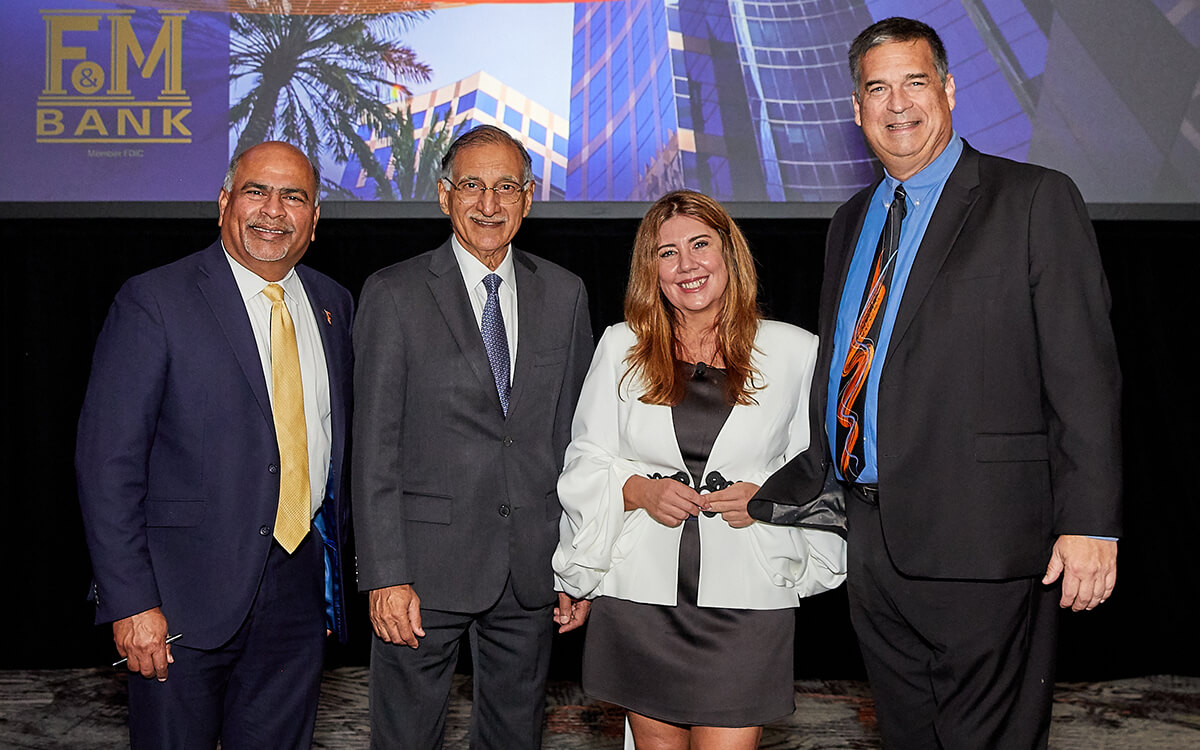
“The economy seems to be doing well, the stock market is doing great, and people are feeling terrible,” said Anil Puri, director of the CSUF Woods Center for Economic Analysis and Forecasting, who presented the report with Mira Farka, co-director of the center.
Puri and Farka offered key takeaways on sticky inflation and other factors affecting the economic, business and housing landscape during their fall 2026 Economic Forecast last week. Hosted by CSUF and the Orange County Business Council, the 32nd annual conference reviewed national and regional trends, the labor market, and the housing market.
U.S. economy bound for ’growthflation’
Contrary to fears that elevated interest rates and geopolitical conflicts would trigger a recession or stagflation, the economists project an extended period of “growthflation” — defined by steady GDP growth in the mid-2% range, sticky inflation in the mid-3% range, and unemployment in the mid-4% range.
A primary economic growth driver is artificial intelligence infrastructure and investment, contributing between 0.9 and 1.1 percentage points directly to national real GDP growth. This accounts for an astounding half of real GDP growth.
Nationally, AI is reshaping the labor force, creating roughly 845,000 technology and infrastructure jobs but displacing about 380,000 “AI-exposed” roles, such as customer service representatives and administrative staff. In California, AI investment accounts for 37% of total real GDP growth in 2026, reinforcing the state’s role as the hub of the technology boom.
Though AI infrastructure, geopolitical conflict, and fuel costs are among drivers placing pressure on inflation, “we don’t think it’s going to get out of hand,” Farka said.
“We don’t think that inflation is going to be insufferably high. It’s just going to be unbearably sticky,” said Farka, CSUF professor of economics.
A ’G-Shaped’ generational divide
The narrative of a “K-shaped” divide between rich and poor is a myth. Lower-wage workers have actually outpaced higher earners in wage growth, gaining 34.8% since 2020 compared to 28.6% for top earners. They have outpaced them in wealth: adjusted for inflation, wealth for the bottom 50% of households has risen by 82% since the pandemic, while wealth for the top 20% by 46%.
However, the real structural divide is “G-shaped” because it is generational. Households over age 70 hold 33.6% of national wealth, while households under age 40 hold just 6.5%. If you compare generations at the same age, in their 30s and early 40s, boomers held 23% of the nation’s wealth, while Gen X held under 10%, and millennials about 11%.
Southern California experiences stalled job growth
Regional hiring across Southern California has slowed to a crawl, with Orange County payroll growth flatlining in 2026. Projections indicate it will edge up to 0.44% in 2027.
“In the last two years especially, there has been minimal growth,” Puri said.
Job growth in Southern California is likely to remain subdued for the next two years while the unemployment rate may tick up in 2027 before easing in 2028.
However, the economists expect the defense and aerospace sector is undergoing a major renaissance driven by defense-tech startups, creating thousands of high-tech engineering jobs.
Housing lock-in & chronic supply strain
Orange County median home prices have risen 4.6% annually since 2023– well above L.A. (1.5%) and California (1.9%). The strain is driven by an inventory deficit running 33% below pre-pandemic levels (only about 4,900 listings). With mortgage rates hovering above 7.4%, the lock-in effect shows no sign of easing.
The researchers expect housing prices to stay within a 2% range for the next year or so.
Housing demand is also rising throughout the state even without meaningful population growth. A few long-term demographic influences help explain the paradox. Birth rates keep falling, the state’s population is aging rapidly, and household formation is accelerating, resulting in more smaller households seeking housing.
“Average household size has been shrinking for the past five years, so more homes are needed to house the same number of people, a trend California shares with the nation as a whole,” the report states.
