

Interest rates and inflation are on the minds of banking executives across Orange County. So is artificial intelligence.
The Orange County Business Journal talked with seven of 11 leaders from OC-based banks, whose combined total assets increased 3.9% to $47.7 billion for the year ended June 30. The executives shared thoughts on economic uncertainty, rising interest rates, business growth opportunities and AI’s evolving role in banking.
- Victor Guerrero, president, Infinity Bank, Santa Ana.
- Carson Lappetito, president and CEO, Sunwest Bank. The bank is based in Utah but was originally founded in Tustin in 1969 and maintains a sizable California headquarters in Irvine.
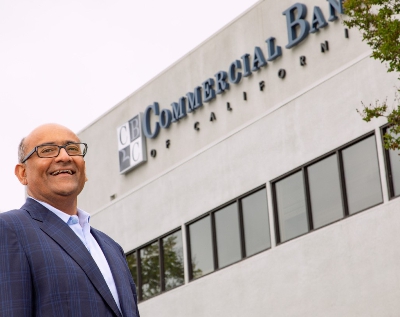
- Ash Patel, chairman, president and CEO, Commercial Bank of California, Irvine.
- Thanh Pham, CEO and president, Cali Bank N.A., Westminster.
- Ivo A. Tjan, founder and CEO, CommerceWestBank, Irvine.
- Henry Walker, CEO, Farmers & Merchants Bank, Long Beach.
- Jared Wolff, chairman and CEO, Banc of California, Santa Ana, Los Angeles.
Answers edited for length and clarity.
What are the biggest economic trends affecting your bank and its customers right now?
Guerrero: Uncertainty, with inflation running a close second. Uncertainty is interesting because it doesn’t actually cost anything, but it can be incredibly expensive. It causes businesses and investors to sit on the sidelines, postponing investments, transactions, and other opportunities while waiting for clarity that may never arrive. Inflation, on the other hand, sends a bill every month through higher operating costs and pressure on earnings.
Pham: Inflation and higher borrowing costs are affecting how businesses make investment decisions. Well-capitalized businesses are well positioned to take advantage of opportunities to acquire real estate and equipment and to expand their operations.
Lappetito: Elevated interest rates. The increase, particularly longer-term interest rates and the expectation for additional rate hikes, has slowed the commercial real estate markets significantly. This is causing transaction volumes to slow materially and debt servicing costs to increase.
Walker: Orange County’s economy remains strong, supported by solid employment and steady business activity. While higher rates and inflation call for thoughtful planning, many clients are investing and growing with confidence.
Patel: Two forces stand out: The cost of doing business and uncertainty about the cost of capital. Inflation is still squeezing margins, while high housing and labor costs make it harder for Orange County companies to hire and retain talent. Yet many businesses remain resilient.
Tjan: Interest rates and inflation continue to impact businesses by putting pressure on profit margins, increasing borrowing costs, and making expansion decisions more challenging. Commercial real estate is particularly sensitive to these conditions.
How have changing interest rates affected the banking environment and customer behavior?
Patel: Interest-rate swings have made business owners far more deliberate. They’re paying closer attention to cash flow, financing structures and the timing of expansion or refinancing.
Walker: Changing interest rates have encouraged clients to be more intentional about borrowing, liquidity, and savings, while a strong economy and healthy job market keep confidence high. Higher deposit rates also help customers earn more on their cash.
Pham: Inflation and higher borrowing costs are affecting how businesses make investment decisions. Well-capitalized businesses are well positioned to take advantage of opportunities to acquire real estate and equipment and to expand their operations.
Tjan: Businesses have become more cautious and deliberate about borrowing, capital investments, expansion, and hiring. Business owners are placing greater emphasis on managing cash flow, protecting profitability, and maintaining liquidity.
Guerrero: I think we’re finally coming to terms with the possibility that the extraordinarily low interest rates we enjoyed for so many years were the exception, not the rule. We may have to get used to paying a more normal price for money.
Lappetito: Whether an investor is buying or developing a commercial real estate project or an entrepreneur is expanding their business through capital investments, the return profile of those investments must be higher to compensate for the higher cost of money. This is causing investors and businesses to be more cautious in how they deploy capital.
Where are banks finding opportunities to grow
Where are banks finding opportunities to grow in Orange County despite the current economic uncertainty?
Wolff: First, Orange County continues to attract investment in healthcare, medical technology, defense and advanced manufacturing — industries where companies need sophisticated financing and treasury management capabilities. Second, economic uncertainty is creating opportunities for well-capitalized businesses to acquire competitors, invest in technology and expand market share. Third, and perhaps most importantly, businesses are re-evaluating their banking relationships. Many have discovered that as banks have grown larger, they’ve become less responsive and more difficult to do business with.
Lappetito: Orange County has experienced a resurgence of its aerospace and defense business. We are seeing established companies growing in this sector as well as new entrants creating cutting-edge defense products at lower costs.
Guerrero: Interestingly, economic uncertainty doesn’t necessarily eliminate growth opportunities. Sometimes our greatest opportunities come from customers who are simply frustrated with their existing bank.
Patel: Orange County still has tremendous opportunity in healthcare, advanced manufacturing and the businesses supporting our tourism economy. We’re also seeing opportunity among entrepreneurs looking to buy the buildings they occupy, expand operations or acquire established businesses.
Pham: We still see opportunities in small business lending. Even during a downturn, there will be strong businesses and good borrowers looking for capital to grow.
Walker: Orange County is thriving, with strong employment and robust activity in Irvine, Newport Beach, Costa Mesa, Anaheim, Huntington Beach, and throughout South Orange County, particularly in healthcare, professional services, manufacturing and commercial real estate.
What economic trend in Orange County do you think isn’t getting enough attention?
Pham: Not a trend to just Orange County (and not purely economic), but the recent proliferation of new trust bank charters creates additional competition for deposits. As deposits move out of traditional commercial banks, that migration would reduce the funding available for lending and constrain economic activity.
Guerrero: I don’t think the continued growth and sophistication of women-owned businesses gets nearly enough attention. We’re seeing exceptionally well-run, innovative companies developing new technologies, advancing healthcare, creating consumer product, and building businesses that compete nationally and internationally. Sometimes I think we still talk about women-owned businesses as though they’re an emerging segment of the economy. They’re not waiting to emerge. They’re already here, and many are doing remarkable things.
Walker: The resilience of Orange County’s small businesses deserves more attention. Supported by strong employment and a healthy local economy, owners continue to invest, adopt new technologies and pursue growth. These businesses are the backbone of our economy.
Tjan: While much of the attention is focused on economic uncertainty, certain industries continue to demonstrate resilience and growth. Legal services, defense manufacturing, businesses supporting artificial intelligence infrastructure and specialty contractors such as HVAC and electrical companies are finding opportunities.
Wolff: We’re already seeing businesses invest heavily in technology and automation, particularly AI, to improve productivity and operate more efficiently. That’s positive for competitiveness and profitability, but it may also mean that companies can grow without adding employees at the rates we’ve historically expected. For Orange County, where the cost of living is already a significant challenge, that raises important questions about the types of jobs we’re creating and how we sustain a strong middle class. I believe this will become one of the defining economic issues of the next decade.
Lappetito: Orange County is experiencing great local growth despite broader economic headwinds and higher interest rates. One of the large drivers of this is the in-migration of individuals and businesses from Los Angeles to Orange County because of the broken policies and high levels of crime in L.A. That migration is creating demand for housing, commercial leasing, offices, restaurants and more.
Patel: We talk about Orange County’s housing costs as a residential issue, but they’re becoming a business competitiveness issue. When employees can’t afford to live near where they work, employers face a harder time recruiting and retaining talent.
How is artificial intelligence changing the way your bank operates?
Walker: We view artificial intelligence as a tool to reduce friction, simplify processes and boost efficiency. It helps our teams streamline workflows and spend more time serving clients and communities.
Patel: AI has the potential to eliminate friction from banking, but it should never replace the relationships at the center of our business. We’re working with Cal State Fullerton on a Responsible AI program to explore how AI can improve workflows, accelerate routine processes and free our team to focus on clients. (Read the Oct. 19 edition of the Business Journal for more about that partnership.)
Tjan: We are focused on leveraging AI to streamline internal processes, enhance decision-making and allow our bankers to spend more time serving clients.
Guerrero: The potential is tremendous, particularly when it comes to identifying risks, improving security, and freeing our employees to spend more time serving customers. But I’m a little skeptical of the idea that AI is going to revolutionize everything overnight. I think AI will eventually become an indispensable tool in banking, but we’re not quite ready to hand it the keys to the vault. And frankly, I haven’t met an AI agent yet that I’d want chairing our loan committee.
Pham: The first step isn’t simply adopting AI. It’s understanding and documenting your processes. Once you know how work actually gets done, you can identify where AI can improve efficiency, decision-making and the customer experience.
Lappetito: Over the past 18 months, we have built internal AI platforms to increase our internal efficiency so we can deliver a better customer experience to our clients. Now we are turning to delivering AI tools and agents to our clients to further enhance their experience, particularly in areas around document collection, forms and other mundane tasks.
Wolff: We are investing heavily in AI. I believe AI will fundamentally change the economics of banking, but perhaps not in the way people expect. Our ambition isn’t to use technology to make banking less personal. It’s to use technology to deliver a level of responsiveness, expertise and service that wasn’t previously possible at scale.
